

Hi from Berlin,
A small confession first: the two big stories in today’s embedded lending edition aren’t really embedded lending. But once you dive into the PayPal and Debenhams stories, I think you’ll see why I picked them. When we build embedded finance products, it’s always worth looking left and right: at what fintech companies like PayPal are doing, and at non-financial brands like Debenhams that offer financing to their sellers without embedding it themselves.
Morten is back as a Friend of EFR, and this time with a specific role. If this fintech GTM role sounds interesting, reach out to Morten or me.
In this edition: Debenhams lets Storfund pay its marketplace sellers on the day they ship, PayPal quietly adds YouLend term loans in Germany, Liberis and Qred close their merger, and Teya adds finmid in three new markets. Plus my conversation with Mark Hollemann on building versus partnering in embedded lending, and Yohai Shilon, former CEO of Nayax Capital, on where embedded lending goes next.
Now let’s dive in. 👇
Friends of EFR
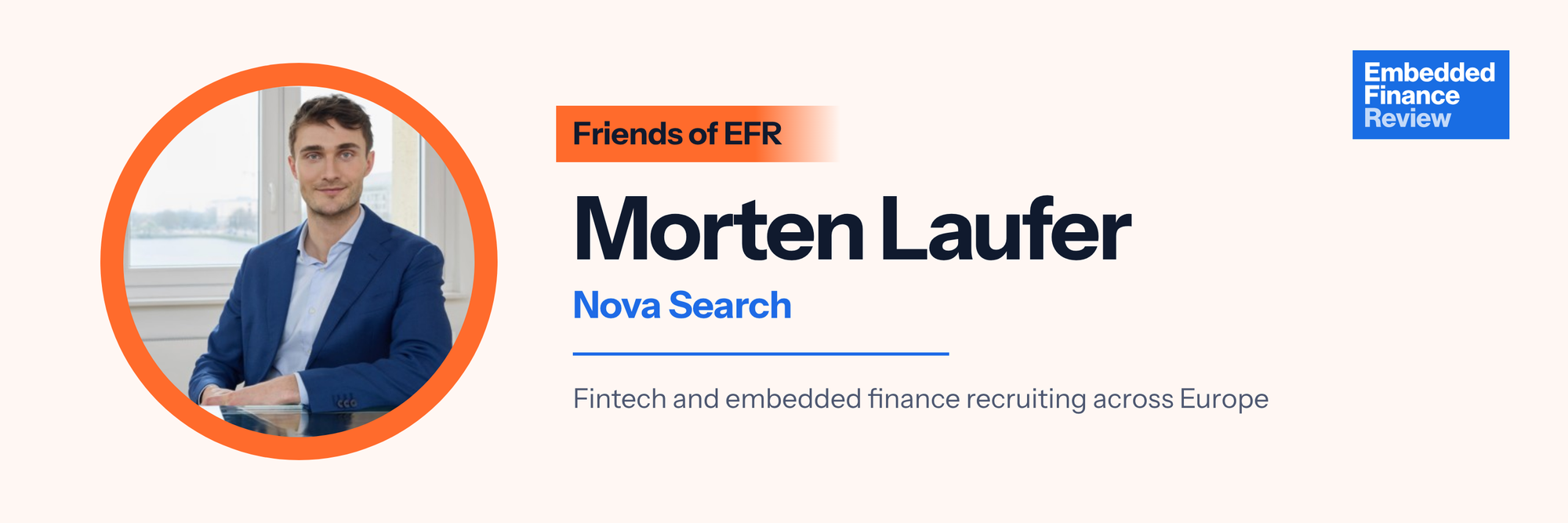
Morten Laufer, Nova Search: Morten is not just any recruiter. He is well known in the fintech ecosystem and is the person I send people to when they are hiring or looking for their next role. He recruits for fintech and embedded finance companies across Europe, and has worked for embedders and enablers alike. You might also know him from my podcast. Growing your team or open to a move? Reach out to Morten and tell him that Lars sent you.
Embedded Lending News
Debenhams lets Storfund pay its sellers on the day they ship: The former high-street department store, now an online marketplace group, has added Daily Advance from London-based Storfund for the brands selling on its marketplaces. Eligible sellers can draw up to 80% of their shipped sales every day, and once Debenhams makes its standard marketplace payment, Storfund releases the remaining 20%, minus its fees. There is no subscription, no set-up fee and no minimum term. With third-party brands at 38.9% of group GMV and a target above 50%, Debenhams now has a reason to care about its sellers' cash flow. But whose product is this, and could it be Debenhams' first step into embedded lending? (Read the full story)
PayPal quietly adds YouLend term loans in Germany: German merchants can now borrow between €1,000 and €1m for up to a year through a fixed-term loan the payments company lists next to its own Businesskredit, with a single fixed fee, fixed weekly repayments and payout from the next working day. YouLend arranges the loan and runs the application, while its sister company Banking Circle provides the money. PayPal has not announced it, and its UK, French and Dutch pages do not list it. Strictly speaking, this is not embedded finance, as the small print says PayPal does not offer, grant or service the loan. So why would a company that already lends point its merchants to someone else's loan? (Read the full story)
Liberis and Qred close their merger: The London embedded lending provider and the Swedish digital business bank are now one group, after the Swedish Financial Supervisory Authority approved the deal Nordic Capital announced in June. Qred founder Emil Sunvisson is group CEO, Liberis CEO Rob Fairfield is deputy CEO, and both brands stay for now. Liberis brings more than 30 platform partners, including Deliveroo, Vagaro and Nexi. For those platforms, the lender behind their capital product now sits inside a licensed bank with a deposit-funded balance sheet. I expect that to mean cheaper funding, and I would ask whether partners will see it in their pricing. (Finextra)
Teya adds finmid as lender in three new markets: Merchants of the London payments and software provider for small businesses can now get pre-approved cash advances inside the Teya app in Croatia and Hungary, with a pilot running in Portugal. Payouts take a median of three minutes, and repayment comes out of monthly revenue. finmid handles underwriting, compliance, and servicing, and provides capital and pricing offers based on real-time Teya performance data. finmid says more than 500 Teya merchants have been financed so far. In the UK, Teya Cash Advance runs with YouLend, and Teya has worked with Liberis and iwoca before, so I expect it to keep picking lenders market by market rather than one for all of Europe. (The Paypers)
Planet and Verifone put YouLend in front of their merchants: Two more payment providers now offer YouLend's revenue-based funding. Planet, which sells payments and software to retailers and hotels, including hotel property management software, has gone live in the UK, Ireland, the Netherlands, Belgium, France, Germany, and Denmark, with YouLend handling underwriting, pricing, and servicing, and Planet connecting eligible merchants (Finextra). In the US, Verifone has launched Commander Capital, powered by YouLend, for fuel and convenience retailers on its Commander platform, which runs in more than 55,000 sites (Verifone).
Credibur checks the assets behind lending facilities: The Berlin lending infrastructure company now acts as a verification agent in debt facilities. Between reporting dates, it checks that the assets behind a facility exist, are assigned correctly, and produce the reported cash, reconciling collections daily from bank and payment accounts. Credibur says six banks and debt funds already use it in live facilities, in addition to its roles as Calculation Agent, Cash Manager and Backup Servicer. After the double-pledging cases in 2025 (where certain companies double pledged assets to various lenders) I expect the capital providers funding such books to ask for exactly these checks. (Credibur)
Walmart Business opens its own invoice terms to all eligible customers: The US retailer's B2B arm now offers Pay By Invoice to every eligible business customer, after running it with a select group since September 2025. Customers get a line of credit on 30-day net terms, usable online, in the Walmart Business app and in-store, with TreviPay running underwriting and receivables behind it. Unlike the BNPL buttons I keep skipping, the programme carries Walmart Business's own name. Who holds the credit risk is not public. (Finextra)
Other Embedded Lending Bits
Build or partner? Back to my conversation with Mark Hollemann: Most companies in this edition did not build a full lending product themselves. Debenhams brings in Storfund, PayPal points German merchants to YouLend, and Teya, Planet and Verifone partner with finmid and YouLend. Mark co-founded Sprinque, a B2B embedded lending provider that reached $1m in ARR before shutting down, and in our episode he walks through what building a lending product actually takes, from underwriting engines to debt financing, and when partnering makes more sense. (Listen to the episode)
Building something in embedded finance? Whether you are a brand comparing providers, an enabler working through your go-to-market strategy, or a team trying to fill a crucial (fintech) role, my office hours are a free call to talk it through. I share my honest read and, where it helps, intros to my network.
Embedded Lending Builder

Yohai Shilon, co-founder and former CEO of Nayax Capital: Few people have taken an embedded lending programme from a blank page to an exit, and Yohai Shilon is one of them. He co-founded Nayax Capital with Alon Feit as a joint venture between Nayax, the Nasdaq-listed payments platform behind card readers in vending machines, kiosks and other unattended retail, and Bank Hapoalim. It started by financing those card readers and kiosks for operators, with repayment taken as a share of the sales running through the same device. From there it added equipment and working capital financing, became fully automated and grew into a programme running in more than ten countries, which I rarely see in embedded lending. In 2025, Nayax bought out the remaining 51% and folded it into its embedded finance division. I asked him where embedded lending goes next:
“The next phase of embedded lending is ownership, not partnership. For a decade, platforms rented their customers out to third-party lenders. Now they’re feeling the friction. In an AI-driven market, proprietary transaction data is the asset everything else is trained on, and sending it into someone else’s credit model means giving it away. Platforms will want to own their financing, not just host it.”
“Platforms went global years ago; embedded lending is still mostly a national business. Payments scale across borders with one integration. Lending doesn’t: every country brings its own licensing, collection mechanics, disclosure rules and funders. That’s why many programs focus in one market. Going global in payments took an integration. Going global in lending takes a different architecture, and it is better to be built-in from day one.”
You can find Yohai on LinkedIn.
That's it for this edition. If you enjoy my newsletter, podcast, or events, the best way to support me is to share them with others in your network. Feedback is always welcome, too.
Need help with an embedded finance project? Visit my website and let's talk.
Best wishes from Berlin,
Lars Markull (LinkedIn)


