

Hi from Berlin,
In January 2020, Angela Strange of Andreessen Horowitz published an essay called "Every Company Will Be a Fintech Company", predicting that nearly every company would one day earn a significant share of its revenue from financial services. Around that time, I decided to go all in on embedded finance. I had left open banking in March 2019, spent the rest of that year looking into fintech infrastructure, and joined Weavr in October 2020.
Almost seven years later, I wanted to see how much of her prediction has come true. Toast makes 82% of its revenue with financial services, Shopify 78%, and in Europe Mews and allO are at around 75%. You have probably seen these numbers somewhere before, but they sit scattered across filings or outdated blog posts.
So I took all the numbers I've collected over the years and put them on one page (including sources) and I'll update it every quarter. The revenue generated by financial services is the most important aspect for many, but I keep emphasising to my clients and readers that there is more. To prove this, I also added public statements in which companies put numbers on effects that don't show up directly on the revenue line.
See how much brands earn with embedded finance
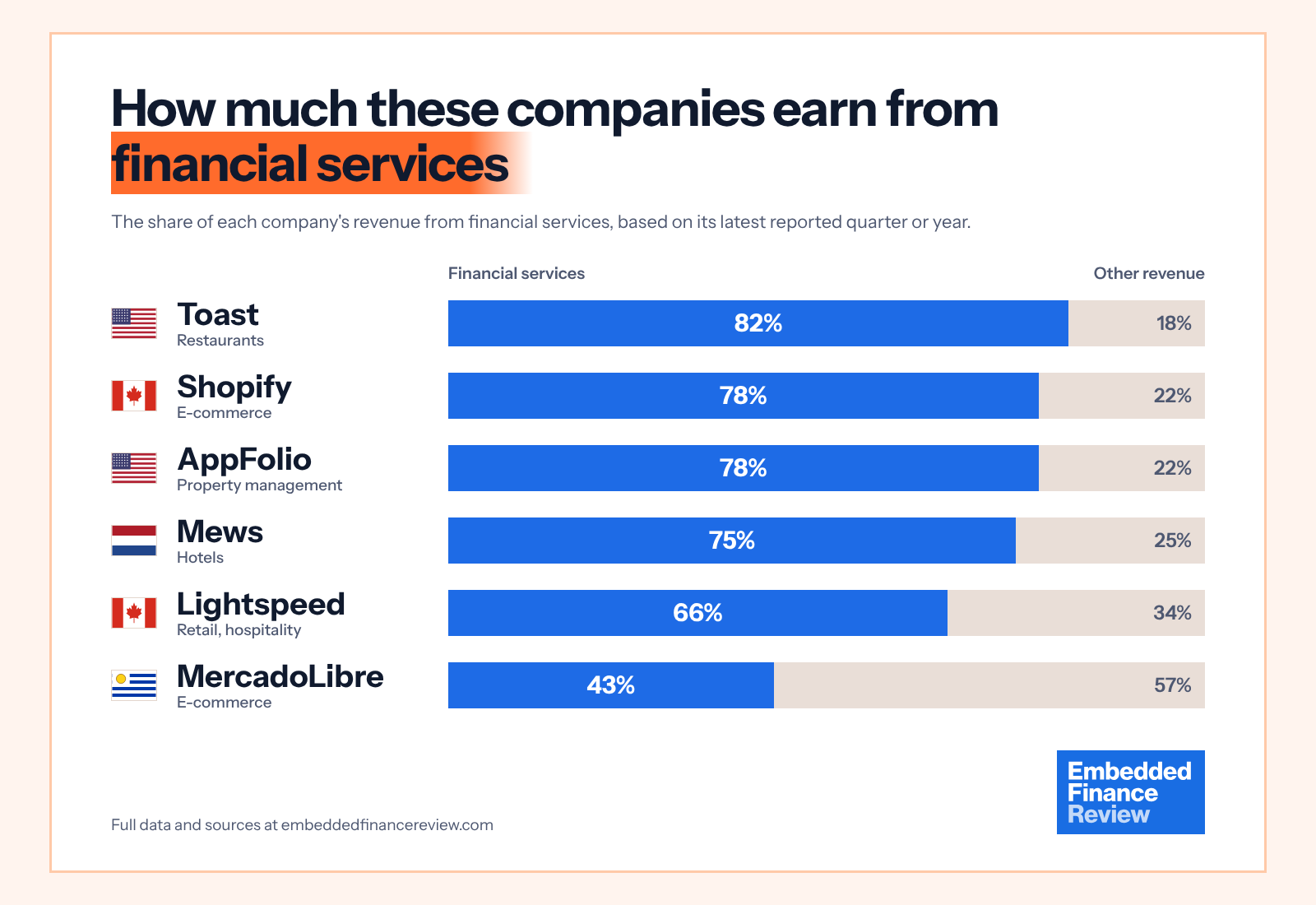
And if your company isn't featured yet, but you would like to be, just get in touch with me.
Also in this edition: Sage brings business accounts into its software in France, Amazon keeps seller money inside with Seller Wallet GBP, Accountable adds investing, Pliant and Griffin raise money, Qonto gets its banking licence, plus Juho Putkonen from Procountor in the builder segment.
Now let’s dive in. 👇
Embedded Banking News
Sage is bringing business accounts and debit cards into its software, starting in France: The UK accounting, HR and payroll software provider has announced an embedded banking offering for small businesses, though it has no launch date yet. Customers will get a business account and a debit card inside Sage's software, with Adyen as the Banking-as-a-Service provider in France and the cards on Mastercard's network. Sage positions the account to sit alongside customers' existing bank account rather than replace it. Starting in France makes sense to me, because mandatory e-invoicing is pulling bookkeeping and banking together, and Sage has confirmed to me that its French customers will get French IBANs. It's also a change of direction: until now, most of what I read about Sage's embedded offering went the other way round, with banks such as HSBC putting Sage's accounting into their own apps. Read the full story
Amazon keeps seller money inside with Seller Wallet GBP: Sellers on the UK store, based in the UK or abroad, can now hold their proceeds in pounds inside Seller Central. With this balance, merchants can pay UK suppliers straight from the wallet and move money to a UK bank account free of charge. The launch comes a few months after Amazon Payments UK became an FCA-authorised e-money institution, and follows similar wallets for USD and EUR. Until now, a UK seller's proceeds left Amazon on every payout, while with the wallet the money stays with Amazon until the seller decides where it goes, so a supplier invoice can be paid straight out of Amazon sales. I'd expect cards to be the next step, so sellers have more options to spend the balance, and the offering could start to look like other business bank offerings. Read the full story
Accountable adds investing after banking and payments: Germany is introducing a new state-subsidised retirement investment account (Altersvorsorgedepot) from 1 January 2027, and for the first time the self-employed can get the subsidies too. The tax app for the self-employed in Belgium and Germany plans to offer its own from the start and has opened a waitlist. Users pick ETFs and funds, while Accountable opens the account, applies for the state subsidies and pulls everything into the tax return it already prepares for them, without charging a fee of its own. That would make it Accountable's third financial product, after its business account and card acceptance, both with Swan. The account runs through a BaFin-licensed partner that Accountable hasn't disclosed yet, but since Accountable handles the onboarding and the tax side, I'd expect a white-label product under its own brand rather than a referral. (Accountable)
S4BT puts Pliant's cards into travellers' phones, as Pliant raises $80m: The Berlin B2B payments and card issuing provider has raised a Series C led by Seaya Nova and Speedinvest, following a $40m Series B in April 2025, and says it passed $100m in annual recurring revenue in July after entering the US. The money goes into North America, further markets and an AI roadmap that includes Pliant for Agents. Software platforms use Pliant's API and white-label components to embed cards inside their own products, and the business travel technology company S4BT is a fresh example. Under Trevium, its own finance technology brand, business travellers can add the virtual card for their hotel booking to their phone wallet. With this card, they can pay for the hotel stay and any additional expenses, which replaces personal out-of-pocket payments and expense claims. (FinTech Futures, The Paypers)
Griffin raises $20m and adds cards to its bank for platforms: The UK bank built for fintech companies and platforms has closed a Series B led by Octagon Partners at a valuation above $100m, and says the round supports its path to profitability. The money goes into card issuing, so customers can launch their own branded debit cards on the same infrastructure as their accounts and payments, with a credit card to follow, and into stablecoin services. Griffin has grown from five corporate customers to more than 80 since getting its full licence in 2024, among them Uber with its Pro Card for UK drivers. For platforms already banking with Griffin, cards from the same bank mean one fewer party in the chain. I spoke with Phoebe Wallis, Griffin's CRO, about why a provider's licence matters on the podcast in October. (FinTech Futures)
Qonto gets its banking licence: The French finance management platform for small businesses has been granted a credit institution licence by the ACPR and the ECB, after applying in July 2025. Qonto has operated under a payment institution licence since 2018 and now serves more than 750,000 SMEs and freelancers in eight markets. Deposits will be covered by France's deposit guarantee scheme up to €100,000, and interest on business account balances starts in Germany on 24 November. The first lending products, including credit lines and invoice financing, are planned for the first half of 2027. Qonto also sells its accounts to other brands through its embedded banking offering, and it's still unclear what the licence changes are for those partners. (FinTech Futures)
DoorDash opens its courier account to apps on Plaid: The US delivery platform's own banking product for couriers, Crimson, with Starion Bank behind it, now connects to the more than 9,000 apps on Plaid's network. Dashers can share their earnings data with lenders so credit applications reflect what they actually earn, and link their accounts to budgeting and payment apps. Crimson counts more than two million Dashers, who get their earnings after each delivery. (The Paypers)