

In January 2020, Angela Strange of Andreessen Horowitz published an essay called "Every Company Will Be a Fintech Company". She predicted that nearly every company would one day earn a significant share of its revenue from financial services. A few months later, Shopify announced Shopify Balance, a business account for its merchants.
For me, it was one of the first non-financial brands the market started to treat as a fintech. It was also the moment I went all in on embedded finance. I left open banking in March 2019 and spent the rest of that year exploring fintech infrastructure. Around the time of Angela's essay, I decided to work on embedded finance full time, months before I joined Weavr in October 2020.
Almost seven years later, how much of her prediction has come true? Toast makes 82% of its revenue with financial services, and Shopify and AppFolio 78% each. In Europe, Mews and allO are at around 75%.
I often end up in conversations about what embedded finance actually does for a company, so I started collecting the numbers. Most of the benefit shows up in revenue, so that is what most of this page tracks. Revenue is an important way to measure success, but there are others, so I have also collected what companies say about the other effects.
This is the first version, published in November 2026. I aim to update it regularly as new statements and numbers are available.
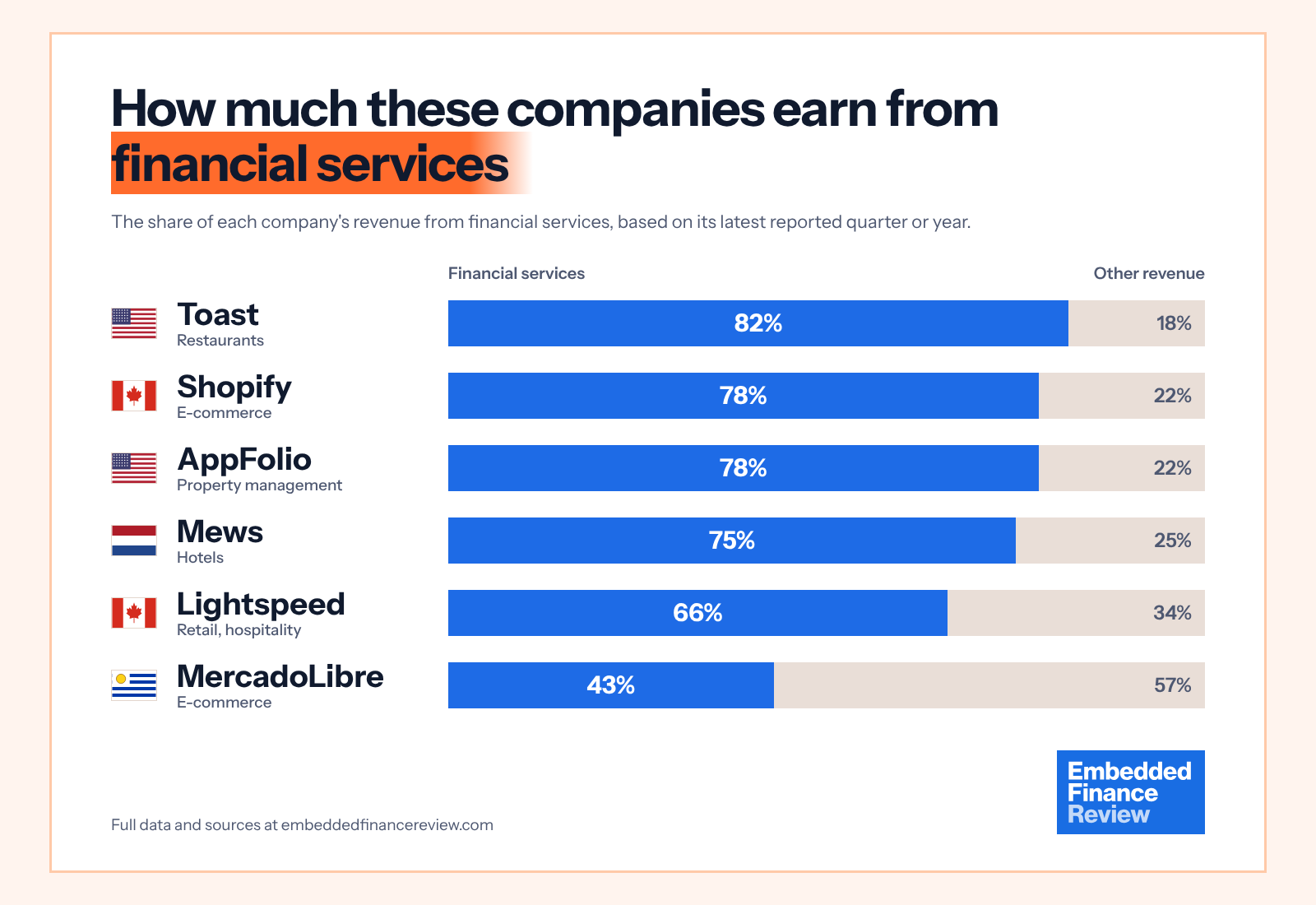
How much revenue do Toast, Shopify and other companies make with financial services?
Toast: 82%
Toast is a Boston-based software company for restaurants, covering the point of sale, online ordering, payroll and payments. In the third quarter of 2026, Toast earned US$1.62bn of its US$1.98bn revenue from financial services. Most of it comes from card payments at the restaurant point of sale, plus Toast Capital loans. Toast focused on payments from the beginning, and in 2019, at US$665m revenue, the financial services revenue share was already around 80%.
Shopify: 78%
Shopify is the Canadian e-commerce platform that merchants use to run their online stores and, increasingly, their physical shops. Shopify generated 78% of its revenue from Merchant Solutions, US$2.91bn of US$3.74bn, in the third quarter of 2026. Merchant Solutions is mostly financial services, but it also includes shipping labels and referral fees, so the actual financial services share is slightly lower. Shopify also offers the widest range of financial products among the role models, from Shopify Balance accounts to the Shopify Credit Card.
AppFolio: 78%
AppFolio is a Californian software company for property managers, who use it to run their rental portfolios, from listings and leases to rent collection. AppFolio makes 78% of its revenue with Value Added Services, US$232m of US$296m in the third quarter of 2026. Its customers are property managers, but the transactions behind this line happen between them and their renters: rent paid online, screening checks on new applicants and risk products such as FolioGuard. Screening and insurance sit in the same line as payments, so the number is a bit broader than financial services alone.
Lightspeed: 66%
Lightspeed is a Montreal-based point-of-sale and commerce platform for retailers and restaurants. Lightspeed makes 66% of its revenue with payments and Lightspeed Capital, US$213.9m of US$323.8m in its quarter to September 2026. It is the role model that caught up late. In fiscal 2021, the share was only 37%. Since then, Lightspeed has pushed its own payments in North American retail and European hospitality, and 45% of the transaction value on its platform now runs through Lightspeed Payments.
MercadoLibre: 43%
MercadoLibre runs the largest e-commerce marketplace in Latin America, founded in Argentina and headquartered in Uruguay. MercadoLibre generates 43% of its revenue from its fintech business: US$4.61bn of US$10.75bn in the third quarter of 2026. Unlike the other role models, most of it comes from lending: consumer and merchant loans through Mercado Pago, the licensed fintech company inside the group.
Phreesia: 30%
Phreesia runs patient intake for US healthcare providers: the software patients use to check in and fill out forms before an appointment. Phreesia makes 30% of its revenue with payments, up from 24% a year earlier. Most of the jump came from buying AccessOne, a patient financing business, in November 2025.
ServiceTitan: 25%
ServiceTitan is the software behind plumbers, electricians and heating and air conditioning contractors in the US. ServiceTitan makes 25% of its revenue from usage fees, mostly payments and financing. When a technician quotes a new air conditioning unit, the homeowner can apply for financing on the spot and pay in instalments, which makes it easier for the contractor to sell the bigger job. Usage revenue was US$72m of US$293m in the quarter to July 2026 and also includes a few non-financial products.
Why do some platforms earn more from financial services than others?
When you look at these companies and their shares, one thing stands out: every company above 60% has payments at the core of its financial services. Toast, Shopify, AppFolio and Lightspeed all sit in the money flow their customers handle every day, whether that is a card payment at the till or rent collected online. Lending, cards and accounts add to it, but payments clearly bring the volume. Where payments play a smaller role, the share is lower, as the full table below shows. For example, the Swedish accounting software Fortnox, without a card terminal, reached 16%, and MercadoLibre, where lending is a bigger part, sits at 43%. So if a platform wants financial services to become the majority of its revenue, I expect it has to own payments.
Revenue is also only one way to measure the positive impact of embedded finance, and lending shows this best. Loan revenue is often small, but Shopify has shared insights from its own study that show the bigger effect. Shops that took funding through Shopify Capital grew sales, on average, 36% more over the following six months than comparable shops. More sales mean more payment fees and fewer reasons for merchants to leave, and none of that shows up as lending revenue. ServiceTitan's homeowner financing works the same way, because it helps the contractor win the job inside ServiceTitan. I would therefore argue that the financial services share in this tracker is the minimum, and that the overall impact is higher—in some cases, much higher.
What does embedded finance do for a platform beyond revenue?
So what does that higher impact look like? Shopify and ServiceTitan are only two examples. Over time, I have come across more brands that talk openly about what embedded finance does for their business, and I collect those statements here. These are their own numbers, so I can't check them, but each one links to where it was said. I'll keep adding to the list as new ones come in.
- Shopify: According to Shopify, shops that took funding through Shopify Capital had 36% higher sales in the following six months than comparable shops without it.
- Toast: Toast says its non-payment fintech products, led by Toast Capital, generated US$57m in gross profit and added nine basis points to its take rate in Q2 2026 (Nasdaq).
- ServiceTitan: according to its IPO filing, contractors that offer financing close 12% more jobs at a 13% higher ticket size.
- Allegro: Allegro says 52% of Allegro Pay loans lead to additional purchases on its marketplace.
- Just Eat Takeaway.com: together with YouLend, it has passed €150m in financing to restaurants and takeaways across seven European markets.
- Circula: CEO Nikolai Skatchkov says the corporate card helps Circula close deals it otherwise would not have won. (EFR)
What the research shows
Beyond what brands say about themselves, I also looked for credible research with real numbers and public data.
- Valuation: Software platforms with embedded finance trade at a 23% premium on revenue multiples and 19% on EBITDA multiples, according to William Blair (September 2025). The more products, the higher the multiple: 8.4x revenue for software only, 9.7x with payments, 12.7x with several financial products.
- Retention: In the same report, gross revenue retention is 89% for customers who only use the software and 95% for customers who also use the financial products. Median revenue growth is 17% for software-only platforms against 22% with embedded finance.
- Europe: Over the last ten years, embedded finance volumes grew three times as fast as directly distributed loans, according to McKinsey (July 2024). Embedded channels made up 5 to 6% of retail and SME lending revenues in 2023 and could reach 20 to 25% by 2030.
Full data and sources
| Company | Vertical | HQ | Period | Share | Prior year | Revenue line | Source |
|---|---|---|---|---|---|---|---|
| Toast | Restaurants, retail | US | Q3 2026 | 82% | 82% | Financial technology solutions | Q3 2026 (10-Q) |
| AppFolio | Property management | US | Q3 2026 | 78% | 77% | Value Added Services | Q3 2026 (results) |
| Shopify | Commerce platform | Canada | Q3 2026 | 78% | 75% | Merchant Solutions | Q3 2026 (10-Q) |
| Lightspeed | Retail, hospitality | Canada | Q2 FY27 | 66% | 68% | Transaction-based revenue | Q2 FY27 (results) |
| MercadoLibre | Marketplace | Uruguay | Q3 2026 | 43% | 44% | Fintech | Q3 2026 (10-Q) |
| Blackbaud | Nonprofits, schools | US | Q3 2026 | 34% | 33% | Transactional recurring revenue | Q3 2026 (10-Q) |
| Phreesia | Healthcare | US | Q2 FY27 | 30% | 24% | Payment solutions | Q2 FY27 (10-Q) |
| ServiceTitan | Trades | US | Q2 FY27 | 25% | 24% | Usage revenue | Q2 FY27 (10-Q) |
| Grab | Super app | Singapore | Q3 2026 | 18% | 10% | Financial Services | Q3 2026 (results) |
| Sea | Marketplace | Singapore | Q2 2026 | 18% | 17% | Monee | Q2 2026 (results) |
| Wix | Website builder | Israel | Q2 2026 | 13% | 13% | Transaction revenue | Q2 2026 (results) |
| Mews (private) | Hotels | Netherlands | FY 2025 | ~75% | Transaction revenue | Oct 2026 (Skift article) | |
| allO (private) | Restaurants | Germany | Sep 2026 | ~75% | Company statement | Sep 2026 (EFR podcast) | |
| Fortnox (private) | Accounting | Sweden | Q1 2025 | 16% | 14% | Financial Services | Q1 2025 (interim report) |
The share is reported revenue from financial services divided by total revenue for the latest quarter. For private companies, the number comes from the company or its filed accounts, as shown in the source column. Most companies book card payments gross, so their payments revenue also includes the interchange and fees they pass on to card networks and banks.
The three stages of embedded finance: building, optimising and scaled
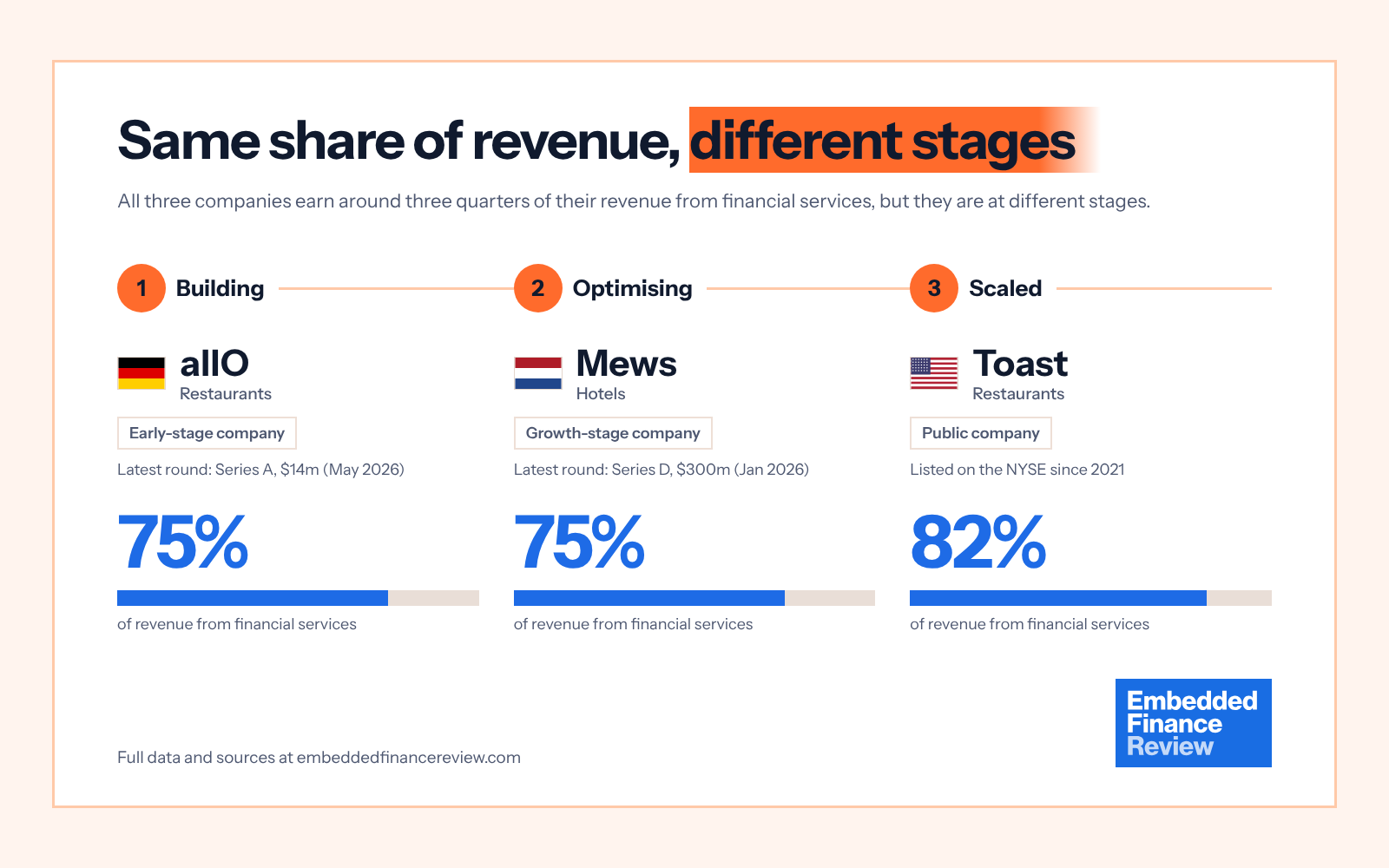
Of course, the revenue share only gets really interesting when you look at it next to the size of the company. A high share at a young startup is one thing; the same share at a public company is another. The table above shows that the share can hold up at scale and most platforms go through three stages: building their financial products, optimising them, and finally running them at scale.
For many companies, though not for all, the share stays fairly stable through these stages. Toast was already at around 80% in 2019 and is at 82% today. Others start lower and grow into it, like Lightspeed, which went from 37% to 66%.
allO, Mews and Toast show what this looks like, one company for each stage. allO, the Munich-based restaurant platform, says about three-quarters of its revenue comes from financial services. It raised a US$14m Series A in May 2026 and is still building. Mews made about 75% of its 2025 revenue from transactions and raised US$300m at a US$2.5bn valuation in January 2026. Payments have been running for years, and Mews is now going one level deeper: in August 2026 it got its own e-money licence in the Netherlands, so it can own more of the payment infrastructure instead of relying only on partners. A step like this improves the margins and the product at the same time, and that is what optimising looks like in practice. Toast, listed on the NYSE since 2021, has scaled and still makes 82% of its revenue from financial services.
Is your company missing?
I hope this tracker and the data behind it are useful. I'll keep sharing it whenever the topic comes up, which is also why I'll keep it updated.
Many vertical platforms, especially in Europe, are private and don't publish their revenue split. If you run one that earns money with embedded payments, lending or cards, I'd love to include you. Just get in touch, and I'll add your company in the next update, with the number attributed to you.


