

Hi Embedded Finance Friend
I am getting ready for this year's TechQuartier Digital Finance Accelerator in Frankfurt. As usual, we are hosting the Embedded Finance Day on May 21st. We crafted a great program for the startups, featuring founders, bankers, VCs, and operators as speakers. The program is behind closed doors. But if you want to mingle with the startups and local ecosystem, sign up for EFR's public networking in the evening, sponsored by Copla and Thunes: Register here.
And if you are building financial products for a non-financial brand, don't forget to fill out our survey for our upcoming Embedded Finance Report: Survey.
And now let’s dive in 👇
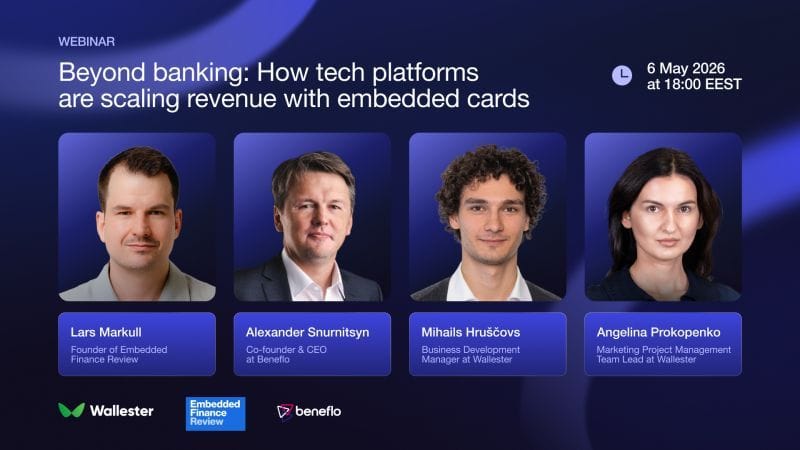
Launching a branded card is one thing. Turning it into revenue is another. On May 6th, I'm joining Alexander Snurnitsyn (Beneflo) and Wallester's team to break down how platforms actually make money with embedded cards: Register here.
TikTok and Visa launch a UK debit card built for creators
What happened: TikTok and Visa launch the Creator Card, a UK debit card and business account for TikTok LIVE creators ++ Designed to give creators faster access to LIVE earnings and separate business from personal finances ++ Neither announcement nor any secondary coverage names the underlying infrastructure provider ++ No public product page yet
TikTok's UK and Irish entities do not hold the FCA licences needed to issue cards themselves, so a regulated third party sits in the stack, almost certainly a UK EMI or a BaaS-backed bank. The UK has a deep bench of issuer-processors and BaaS providers (Modulr, Paynetics, and Marqeta would all be plausible candidates), so there is no need for TikTok to hold its own licences here, unlike in Brazil where TikTok recently applied for its own payment and credit licences. Visa already serves the US creator economy through Karat, but a direct platform partnership with TikTok in the US would mean wading into ownership and divestiture politics. The UK avoids all of that.
Read the full story on Embedded Finance Review
Marginalen Bank turns Swedish licensed bank into BaaS provider
What happened: Sweden's Marginalen Bank launches a new business line called Embedded Banking ++ Two reference customers already live: Safello (crypto exchange, 400,000+ users) and Ekobanken (first indirect Swish participant) ++ Marginalen is the second Swedish bank in BaaS after SEB Embedded ++ Built on a recent Mambu core migration
Marginalen Bank, a small specialist bank ranked 29th in Sweden by total assets, has launched Embedded Banking as a packaged BaaS proposition for non-bank companies. The Swedish BaaS landscape has historically been thin, with companies forced to choose between cross-border providers (foreign IBANs, no native Swish access) or direct partnerships with large Swedish banks. Marginalen is filling that gap with a Sweden-specific stack including Swish indirect access, an angle that genuinely differentiates it locally. The real test is the next three or four customers.
Read the full story on Embedded Finance Review
In other Embedded Finance news
- Shopify applies for a US money transmitter licence: The eCommerce platform is seeking nationwide approval to act as a money transmitter and provider of prepaid access, having already secured licences in 18 states and Puerto Rico, with applications under review in the rest, including New York and California. The move would let Shopify hold and move funds itself and store merchants' balances, deepening its control over how money flows on its platform. (Source)
- Bolttech doubles down on embedded insurance with two new partnerships: The Singapore-based insurtech announced a strategic partnership with German embedded services provider Mehrwerk to combine Bolttech's insurance capabilities with Mehrwerk's cashback and lifestyle protection portfolio for German retail banks (Source). Separately, Chinese EV manufacturer BYD selected Bolttech as its strategic partner for embedded auto insurance (Source).
- CIBC Innovation Banking provides €10M in growth financing to Qover: The Belgian embedded insurance platform that orchestrates insurance for partners, including Revolut, Mastercard, BMW, and Canyon across 32 European countries, will use the funding to support continued expansion. CIBC's UK & Europe Managing Director called embedded insurance "an increasingly important offering, both to leading brands and to their customers." (Source)
- Navro powers Multiplier's new Global Payroll Payments product: UK-based payments infrastructure provider Navro is enabling Multiplier's new end-to-end payroll payments capability, covering FX conversion, multi-country disbursement, and statutory tax filings across 95 countries. Multiplier currently processes $2 billion in cross-border wages annually and expects to reach $4.5 billion by year-end. (Source)
- Collective acquires embedded accounting startup Open Ledger: Collective, an all-in-one financial platform for solopreneurs, has acquired Open Ledger to bring its embedded accounting infrastructure in-house and accelerate the build of an AI-driven financial operating system. Collective serves 13,000+ businesses and manages over $1.4 billion in member finances; Open Ledger's API connects with 12,000+ banks and integrates with Stripe, Plaid, and QuickBooks. (Source)
- Finix launches MCP integrations with ChatGPT, Claude, and Gemini: The US payments processor has rolled out Model Context Protocol server integrations across the three major AI assistants, allowing developers to query Finix's API and documentation, generate code for payment flows, and prototype integrations from within their AI environment. Finix CEO Richie Serna positioned the move as a response to developers increasingly using AI-assisted coding as a primary interface for building software. (Source)
- Meta rolls out stablecoin payouts in Colombia and the Philippines: Four years after shelving its Libra project, Meta has quietly launched USDC payouts to select creators on the Solana and Polygon networks, with Stripe handling crypto-specific tax reporting. Polygon Labs CEO Marc Boiron said the program is expected to expand to more than 160 countries by year-end. (Source)
That's it for this edition. If you enjoy my newsletter, podcast, or events, the best way to support me is to share them with others in your network. Feedback is always welcome, too.
Need help with an embedded finance project? Visit my website and let's talk.
Best wishes from Berlin,
Lars Markull (LinkedIn)


